

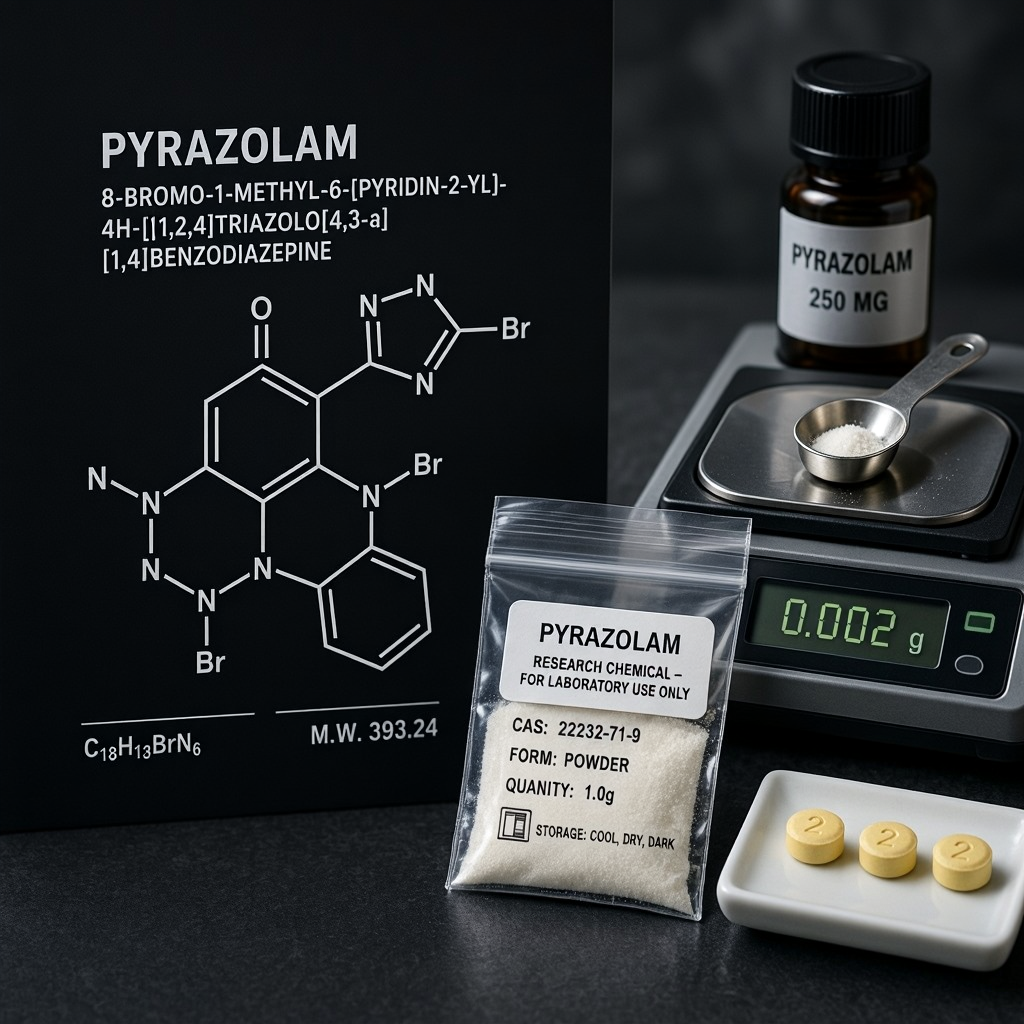
Product Name: Pyrazolam Synonyms: SH-I-04; 8-Bromo-1-methyl-6-(pyridin-2-yl)-4H-[1,2,4]triazolo[4,3-a][1,4]benzodiazepine12
General Description: Pyrazolam is formally described as 8-bromo-1-methyl-6-(pyridin-2-yl)-4H-[1,2,4]triazolo[4,3-a][1,4]benzodiazepine.134 It is a synthetic, psychoactive molecule belonging to the triazolobenzodiazepine subclass.2 Originally developed by a team led by Leo Sternbach at Hoffmann-La Roche in the 1970s, it remained an obscure research chemical until its emergence on the illicit market as a novel psychoactive substance (NPS) and designer drug around 2012.2 Structurally, it is closely related to alprazolam and bromazolam, featuring a 2-pyridinyl group in place of the classic phenyl ring found in most conventional benzodiazepines.2
In analytical, clinical, and forensic toxicology, pyrazolam is utilized as a fundamental reference standard.2 It is essential for the calibration of analytical instrumentation (such as LC-MS/MS and GC-MS) and the development of screening methodologies to identify and quantify the substance in seized materials, counterfeit pharmaceutical tablets, or biological matrices (e.g., whole blood, plasma, urine).2
Technical Information:
- CAS Number: 39243-02-2123
- Molecular Formula: C<sub>16</sub>H<sub>12</sub>BrN<sub>5</sub>134
- Formula Weight: 354.2 g/mol234
- SMILES: CC1=NN=C2N1C3=C(C=C(C=C3)Br)C(=NC2)C4=CC=CC=N412
- InChI Key: BGRWSFIQQPVEML-UHFFFAOYSA-N123
- Formulation: Typically supplied as a neat white-to-off-white crystalline solid or as a certified reference material solution (e.g., 1 mg/mL or 100 µg/mL in methanol or acetonitrile).2
Biological Action: Like other benzodiazepines, pyrazolam acts as a positive allosteric modulator (PAM) at central GABA<sub>A</sub> receptors.2 By enhancing the inhibitory signaling of the neurotransmitter gamma-aminobutyric acid (GABA), it elicits anxiolytic, sedative, muscle relaxant, and anticonvulsant effects.2 Anecdotal and preclinical reports suggest that pyrazolam is highly selective in its receptor subtype affinity, producing robust anxiolysis with comparatively less sedation and ataxia than many of its designer counterparts.2 Notably, unlike the vast majority of benzodiazepines, pharmacokinetic profiling indicates that pyrazolam undergoes minimal hepatic metabolism and is excreted largely unchanged in the urine.2
Regulatory and Safety Information:
- Intended Use: This product is intended strictly for use as an analytical reference standard for forensic, toxicological, and academic research purposes.2
- Warning: This product carries a significant risk of central nervous system depression, physiological dependence, and potentially fatal overdose, especially when combined with other depressants such as opioids or alcohol.2 It is not for human or veterinary use.24
- Legal Status: The regulatory status of pyrazolam varies globally.2 In the United Kingdom, it is controlled as a Class C substance under the Misuse of Drugs Act.2 In the United States, pyrazolam is not explicitly scheduled at the federal level; however, several individual states (such as Alabama) have proactively classified it as a Schedule I controlled substance.2 It is also regulated or banned under generic designer benzodiazepine clauses in numerous European nations.2 Procurement may require relevant local or institutional licenses.2 Handling should only occur within professional laboratory environments using appropriate Personal Protective Equipment (PPE) such as safety glasses, chemical-resistant gloves, and a laboratory coat.2
| Weight | 0.01 kg |
|---|
Be the first to review “Pyrazolam”
Related products

Benzodiazepines


Benzodiazepines

Benzodiazepines


Benzodiazepines
Benzodiazepines
Benzodiazepines


Benzodiazepines

Benzodiazepines
Reviews
There are no reviews yet.