

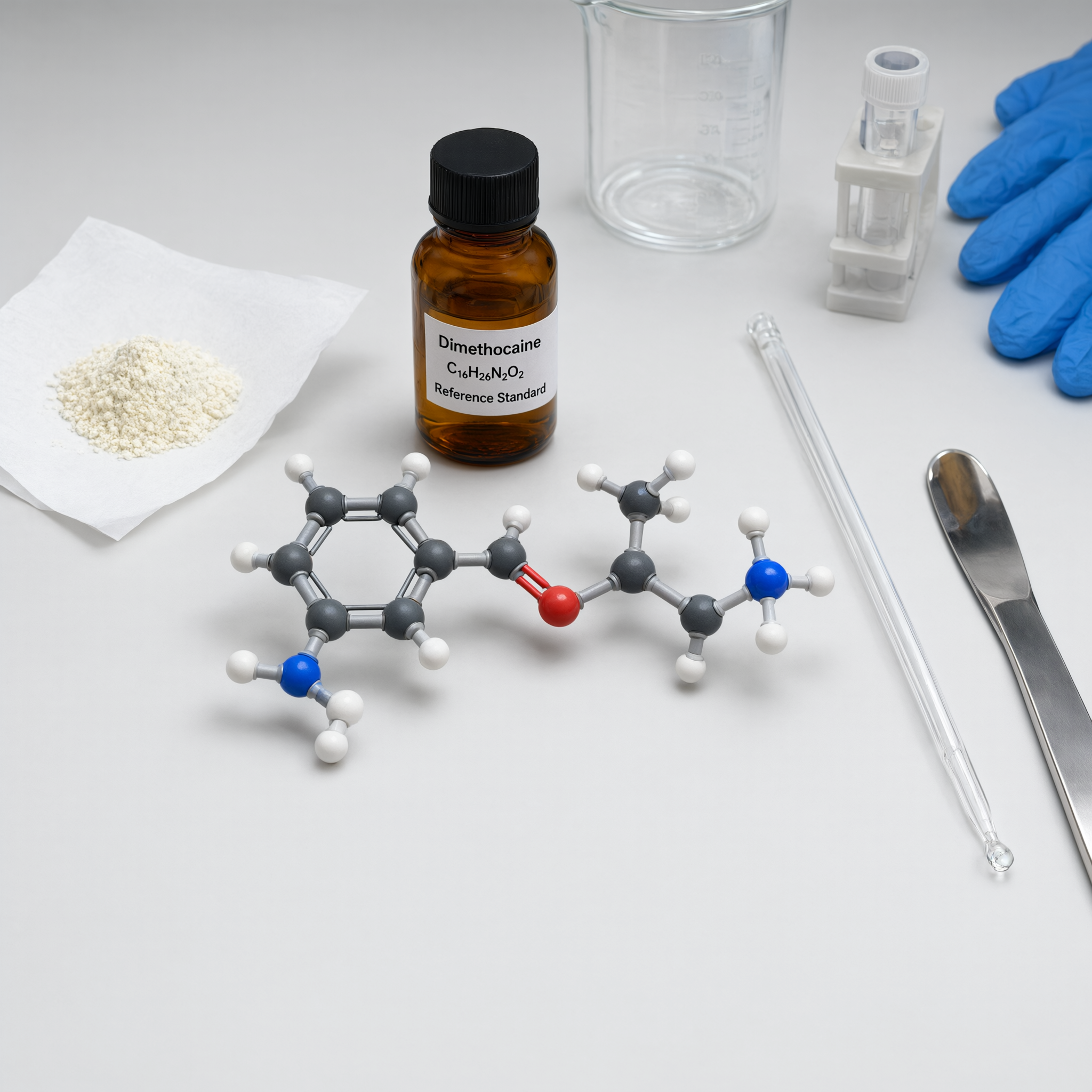
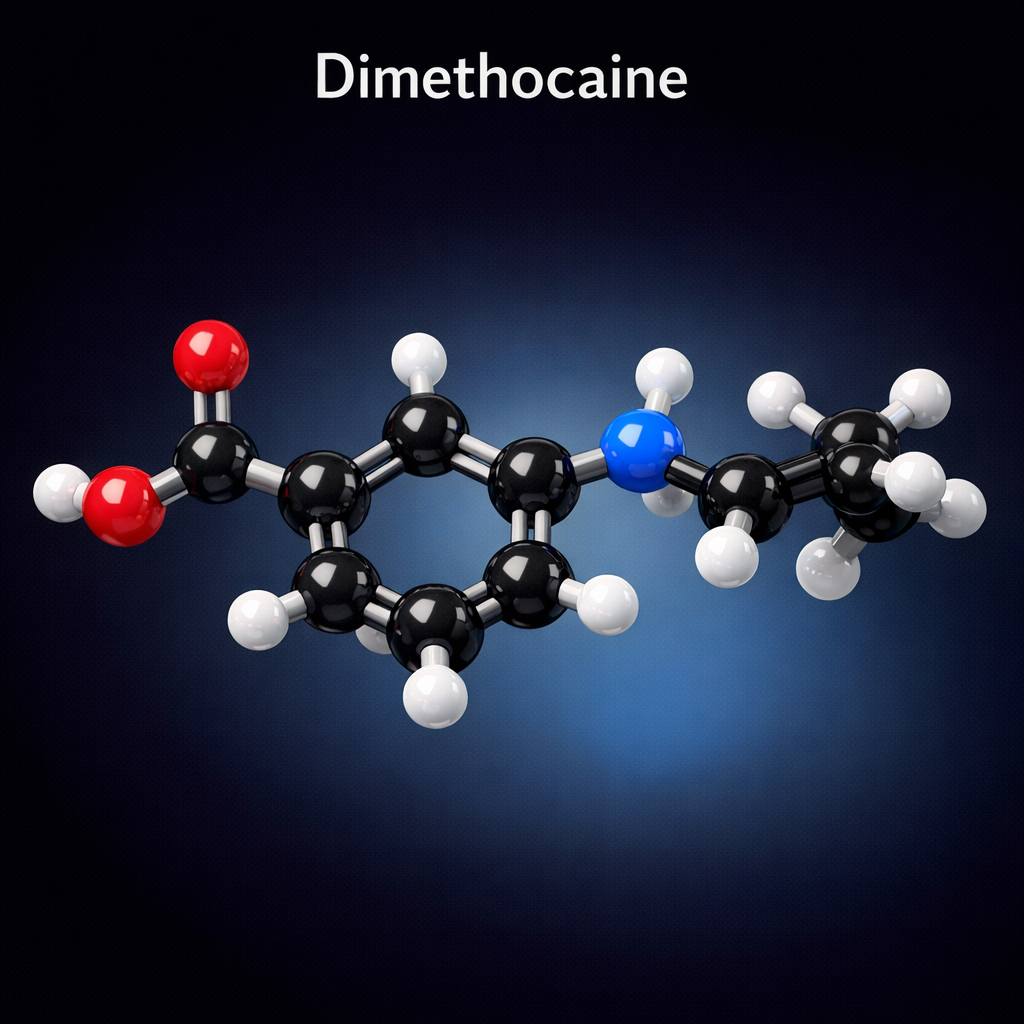
Dimethocaine (DMC) research chemical. Local anesthetic for laboratory research.
Dimethocaine Product Name:
Dimethocaine Synonyms: DMC; Larocaine; (3-diethylamino-2,2-dimethylpropyl) 4-aminobenzoate
General Description: Dimethocaine is formally described as 3-(diethylamino)-2,2-dimethylpropyl 4-aminobenzoate. It is a synthetic, psychoactive molecule belonging to the p-aminobenzoic acid ester class of local anesthetics. Originally synthesized by Hoffmann-La Roche in the 1930s and marketed briefly under the trade name Larocaine, it was eventually largely abandoned in clinical medicine in favor of other anesthetics like lidocaine and procaine. Because it possesses distinct dopaminergic stimulant properties alongside its anesthetic effects, dimethocaine emerged on the illicit designer drug market in the late 2000s as a novel psychoactive substance (NPS) and a “legal high” substitute for cocaine.
In analytical, clinical, and forensic toxicology, dimethocaine is utilized as a fundamental reference standard. It is essential for the calibration of analytical instrumentation (such as LC-MS/MS, GC-MS, and HPLC) and the development of screening methodologies to identify and quantify the substance in seized materials, adulterated illicit street drugs, or biological matrices (e.g., whole blood, plasma, urine).
Technical Information (Hydrochloride Salt):
- CAS Number: 553-63-9 (Hydrochloride) / 94-15-5 (Freebase)
- Molecular Formula: C<sub>16</sub>H<sub>26</sub>N<sub>2</sub>O<sub>2</sub> • HCl
- Formula Weight: 314.85 g/mol (Hydrochloride) / 278.39 g/mol (Freebase)
- SMILES: CCN(CC)CC(C)(C)COC(=O)C1=CC=C(N)C=C1.Cl
- InChI Key: VYZSPCLDCMWTQE-UHFFFAOYSA-N (Freebase)
- Formulation: Typically supplied as a neat white-to-off-white crystalline solid or as a certified reference material solution (e.g., 1 mg/mL or 100 µg/mL in methanol).
Biological Action: Dimethocaine possesses a uniquely dual-action pharmacological profile. Like procaine, it acts as a local anesthetic by blocking voltage-gated sodium channels, preventing the generation and conduction of nerve impulses. However, like cocaine, dimethocaine also acts as a potent monoamine reuptake inhibitor, primarily binding to and blocking the dopamine transporter (DAT). This prevents the clearance of dopamine from the synaptic cleft, mediating its psychomotor stimulant and euphoric effects. While in vivo studies generally characterize it as less potent than cocaine, the combination of profound dopamine accumulation and systemic sodium channel blockade yields a high risk of severe cardiovascular toxicity, including tachycardia, extreme vasoconstriction, and cardiac arrhythmias at supratherapeutic doses.
Regulatory and Safety Information:
- Intended Use: This product is intended strictly for use as an analytical reference standard for forensic, toxicological, and academic research purposes.
- Warning: This product is a psychostimulant and a potent local anesthetic. It carries a significant risk of severe cardiovascular stress, cardiac arrhythmias, central nervous system overstimulation, and physiological dependence. It is not for human or veterinary use.
Related products
Research Chemicals
Research Chemicals