

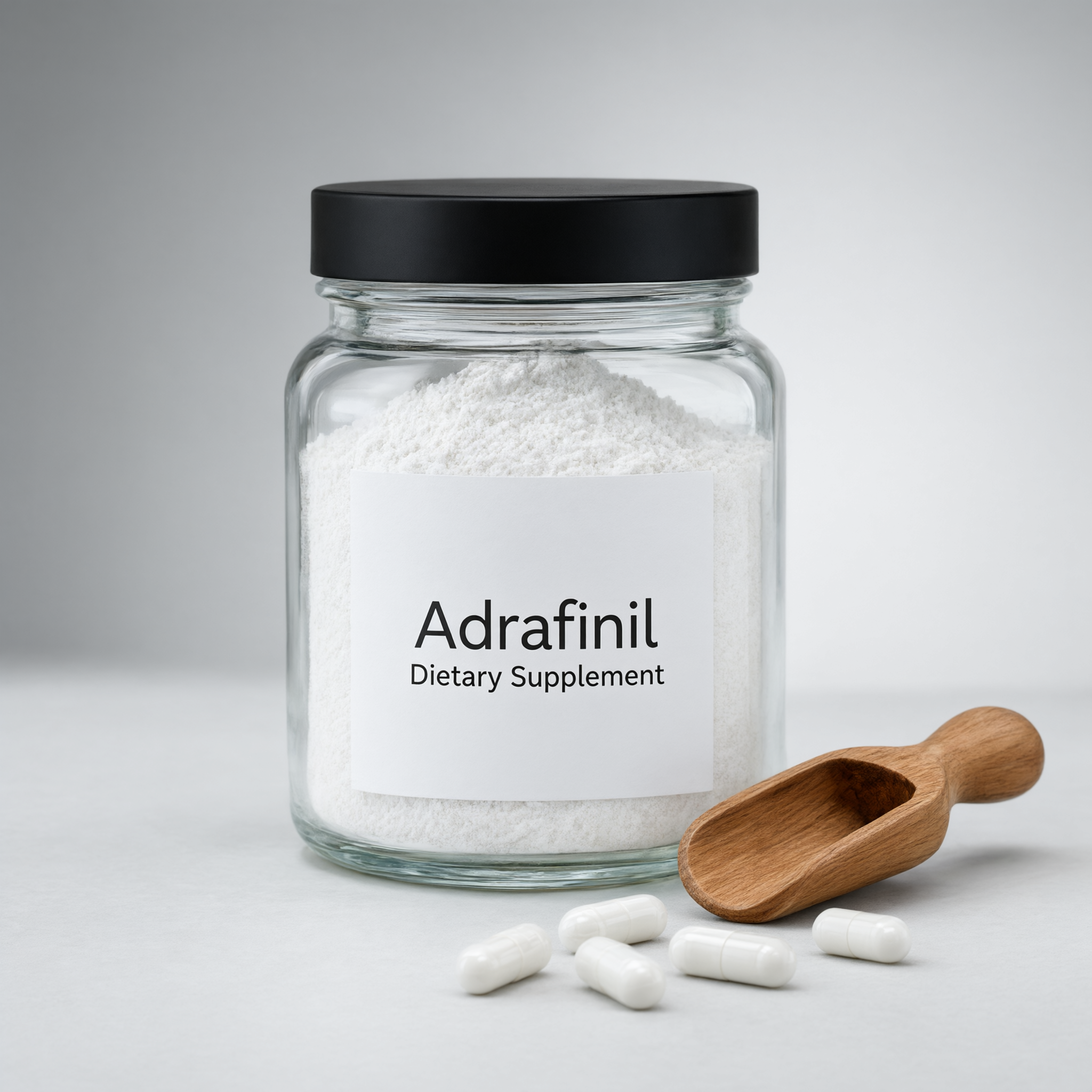

Adrafinil is a prodrug of modafinil, used in research for studying wakefulness-promoting agents and their metabolic pathways.
Purity: ≥98% (HPLC)
Appearance: White crystalline powder
CAS: 63547-13-7
Molecular Formula: C15H15NO3S
Molecular Weight: 289.35 g/mol
For research purposes only.
Product Name: Adrafinil Synonyms: Olmifon; CRL-40028; 2-[(diphenylmethyl)sulfinyl]-N-hydroxyacetamide; N-hydroxy-2-(benzhydrylsulfinyl)acetamide
General Description: Adrafinil is formally described as 2-[(diphenylmethyl)sulfinyl]-N-hydroxyacetamide. It is a synthetic, centrally acting eugeroic (wakefulness-promoting agent). Originally discovered in the 1970s by the French pharmaceutical company Laboratoires Lafon, it was utilized clinically in Europe (under the trade name Olmifon) to treat vigilance issues and excessive daytime sleepiness in the elderly. It was voluntarily discontinued by its manufacturer in 2011. Structurally, adrafinil is the N-hydroxylated analogue of modafinil and serves as a direct biological prodrug to it. In recent years, it has gained substantial popularity on the grey market as an unscheduled nootropic alternative to prescription modafinil.
In analytical, clinical, sports, and forensic toxicology, adrafinil is utilized as a fundamental reference standard. It is essential for the calibration of analytical instrumentation (such as LC-MS/MS, GC-MS, and HPLC) and the development of screening methodologies to identify the substance in grey-market dietary supplements, experimental nootropic blends, or biological matrices (e.g., whole blood, plasma, urine), particularly in anti-doping contexts to differentiate adrafinil ingestion from modafinil ingestion.
Technical Information:
- CAS Number: 27511-99-5
- Molecular Formula: C<sub>15</sub>H<sub>15</sub>NO<sub>3</sub>S
- Formula Weight: 289.35 g/mol
- SMILES: O=C(NO)CS(=O)C(C1=CC=CC=C1)C2=CC=CC=C2
- InChI Key: ZPUZTRVXSSVWNV-UHFFFAOYSA-N
- Formulation: Typically supplied as a neat white-to-pinkish crystalline solid or as a certified reference material solution (e.g., 1 mg/mL in methanol or acetonitrile).
Biological Action: Adrafinil is largely inactive in its original state and relies heavily on in vivo conversion. Upon oral ingestion, it undergoes primary Phase I hepatic metabolism, where the N-hydroxyl group is cleaved to yield the active metabolite, modafinil. Consequently, its pharmacological profile mirrors that of modafinil—acting as a weak, atypical dopamine reuptake inhibitor (DRI) that also elevates hypothalamic histamine and orexin (hypocretin)—but with a significantly delayed onset of action due to the requisite metabolic processing.
A critical toxicological distinction between adrafinil and modafinil is hepatic strain. Because adrafinil must be processed by the liver to become active, chronic or high-dose administration is clinically associated with elevated liver enzymes and a noted risk of hepatotoxicity, a side effect not prominently shared by modafinil itself.
Regulatory and Safety Information:
- Intended Use: This product is intended strictly for use as an analytical reference standard for forensic, toxicological, and academic research purposes.
- Warning: This product carries a risk of hepatotoxicity (liver damage) with prolonged use. It is an unapproved investigational compound in many jurisdictions and is not for human or veterinary use outside of approved clinical applications.
| Weight | 0.01 kg |
|---|
Be the first to review “Adrafinil”
Related products
Nootropics
Nootropics
Nootropics

Nootropics


Nootropics
Nootropics

Nootropics

Nootropics
Reviews
There are no reviews yet.