

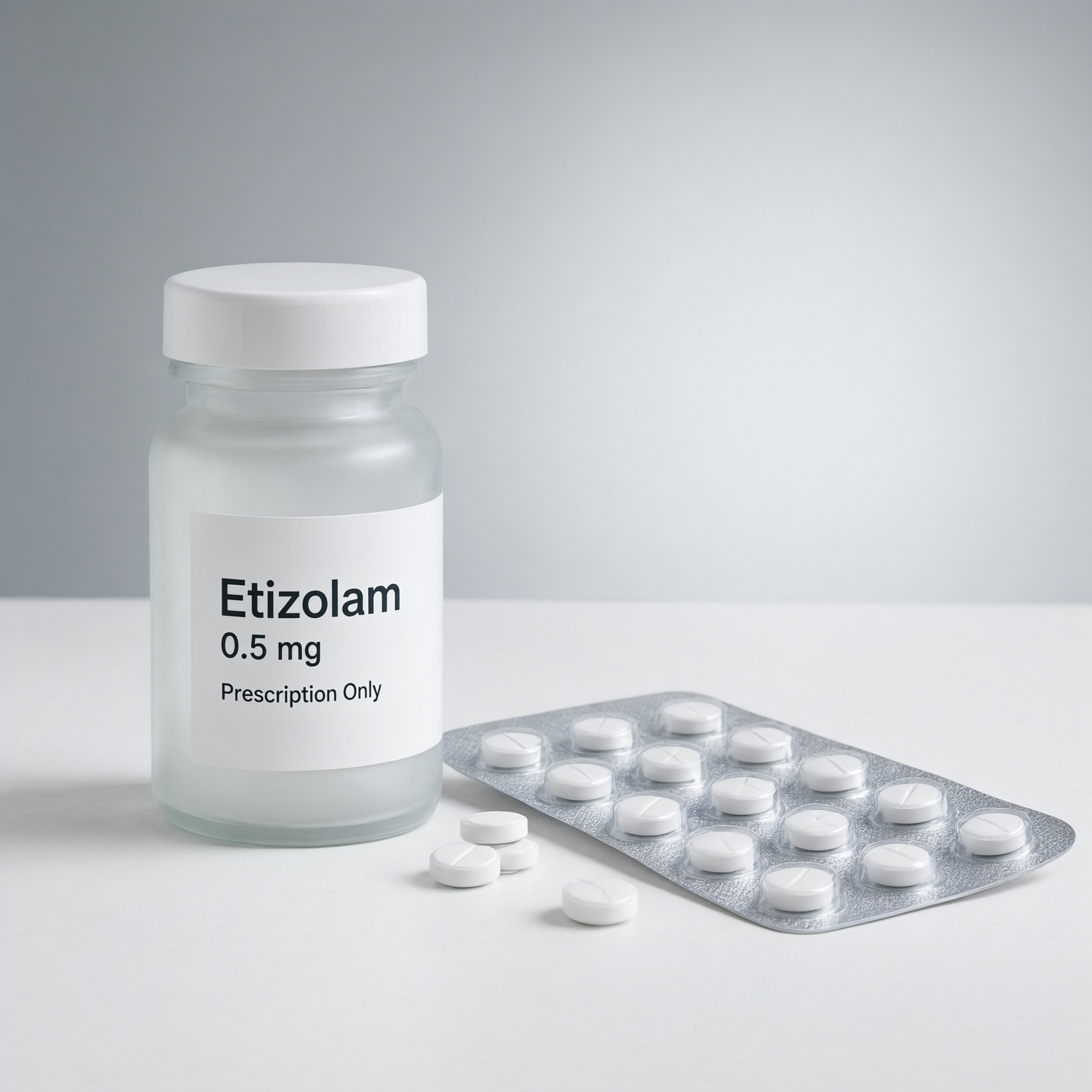
Etizolam is a thienodiazepine derivative used in pharmacological research to study GABA-A receptor modulation and anxiolytic mechanisms.
Purity: ≥98% (HPLC)
Appearance: White crystalline powder
CAS: 40054-69-1
Molecular Formula: C17H15ClN4S
Molecular Weight: 342.85 g/mol
Storage: Room temperature, protected from light.
For research purposes only.
Product Name: Etizolam Synonyms: Etilaam; Etizest; Depas; Pasaden; 4-(2-chlorophenyl)-2-ethyl-9-methyl-6H-thieno[3,2-f][1,2,4]triazolo[4,3-a][1,4]diazepine
General Description: Etizolam is formally described as 4-(2-chlorophenyl)-2-ethyl-9-methyl-6H-thieno[3,2-f][1,2,4]triazolo[4,3-a][1,4]diazepine. It is a synthetic, psychoactive molecule belonging to the thienodiazepine class (specifically the thienotriazolodiazepine subclass). Structurally, it differs from traditional benzodiazepines (such as diazepam or alprazolam) via the replacement of the classic benzene ring with a thiophene ring, alongside the addition of a fused triazole ring. Originally developed and introduced in Japan in the 1980s as a prescription medication for anxiety and sleep disorders, etizolam remains an approved clinical pharmaceutical in a few countries such as Japan, India, and Italy. However, it emerged globally on the illicit market in the 2010s as a prominent novel psychoactive substance (NPS) and designer drug, frequently found pressed into counterfeit pharmaceutical tablets mimicking Xanax.
In analytical, clinical, and forensic toxicology, etizolam is utilized as a fundamental reference standard. It is essential for the calibration of analytical instrumentation (such as LC-MS/MS and GC-MS) and the development of screening methodologies to identify and quantify the substance and its active metabolites in seized materials, counterfeit pharmaceutical tablets, or biological matrices (e.g., whole blood, plasma, urine).
Technical Information:
- CAS Number: 40054-69-1
- Molecular Formula: C<sub>17</sub>H<sub>15</sub>ClN<sub>4</sub>S
- Formula Weight: 342.85 g/mol
- SMILES: CCC1=NN=C2N1C3=C(C=C(C)S3)C(=NCC2)C4=CC=CC=C4Cl
- InChI Key: QYJHVAMKWTZUDD-UHFFFAOYSA-N
- Formulation: Typically supplied as a neat white-to-off-white crystalline solid or as a certified reference material solution (e.g., 1 mg/mL or 100 µg/mL in methanol or acetonitrile).
Biological Action: Like classical benzodiazepines, etizolam acts as a high-affinity positive allosteric modulator (PAM) at central GABA<sub>A</sub> receptors. By enhancing the inhibitory signaling of the neurotransmitter gamma-aminobutyric acid (GABA), it elicits profound anxiolytic, sedative, hypnotic, muscle relaxant, amnesic, and anticonvulsant effects. Pharmacologically, etizolam is highly potent, with an acute clinical profile often compared to alprazolam. It is characterized by a rapid onset of action and a relatively short elimination half-life (approximately 3.4 hours). However, its primary active metabolite, alpha-hydroxyetizolam, is equipotent to the parent compound and possesses a longer half-life (up to 8 hours), which can contribute to prolonged central nervous system depression upon redosing.
Regulatory and Safety Information:
- Intended Use: This product is intended strictly for use as an analytical reference standard for forensic, toxicological, and academic research purposes.
- Warning: This product carries a significant risk of profound central nervous system depression, physiological dependence, and potentially fatal overdose, especially when combined with other depressants such as opioids or alcohol. It is not for human or veterinary use outside of strictly approved clinical environments.
| Weight | 0.01 kg |
|---|
Be the first to review “Etizolam”
Related products


Benzodiazepines
Benzodiazepines

Benzodiazepines
Benzodiazepines


Benzodiazepines

Benzodiazepines
Benzodiazepines


Benzodiazepines
Reviews
There are no reviews yet.