

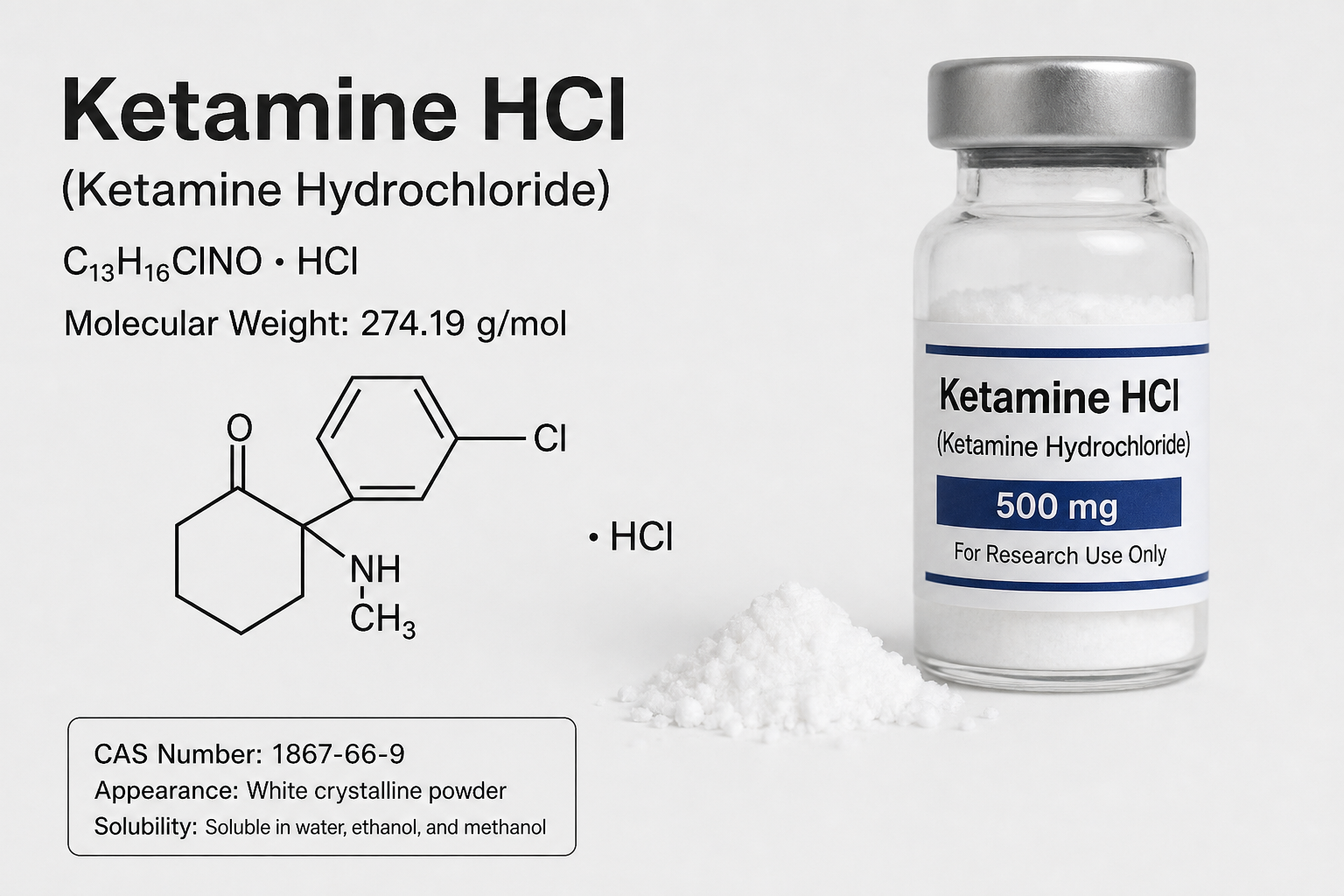



Product Name: Ketamine HCl (Ketamine Hydrochloride) Synonyms: 2-(2-Chlorophenyl)-2-(methylamino)cyclohexan-1-one hydrochloride; Ketalar; Ketaset; CI-581
General Description: Ketamine is formally described as 2-(2-chlorophenyl)-2-(methylamino)cyclohexan-1-one. It is a synthetic, psychoactive molecule belonging to the arylcyclohexylamine class. Originally synthesized in 1962 as a safer alternative to phencyclidine (PCP), it is widely utilized in human and veterinary medicine for the induction and maintenance of general anesthesia. More recently, it has gained significant clinical attention for its rapid-acting antidepressant properties. Conversely, it is also widely encountered in forensic casework as an illicit recreational drug (colloquially known as “Special K”) sought for its dissociative and hallucinogenic effects.
In analytical, clinical, and forensic toxicology, ketamine hydrochloride is utilized as a fundamental reference standard. It is essential for the calibration of analytical instrumentation (such as LC-MS/MS, GC-MS, and HPLC) and the development of screening methodologies to identify and quantify the substance in seized street drugs, adulterated formulations, or biological matrices (e.g., whole blood, plasma, urine).
Technical Information (Hydrochloride Salt):
- CAS Number: 1867-66-9 (Hydrochloride) / 6740-88-1 (Freebase)
- Molecular Formula: C<sub>13</sub>H<sub>16</sub>ClNO • HCl
- Formula Weight: 274.2 g/mol
- SMILES: CNC1(CCCCC1=O)C2=CC=CC=C2Cl.Cl
- InChI Key: PNVTZKCHTOVYHO-UHFFFAOYSA-N (Freebase)
- Formulation: Typically supplied as a neat white crystalline solid or as a certified reference material solution (e.g., 1 mg/mL or 100 µg/mL in methanol).
Biological Action: Ketamine acts primarily as an uncompetitive antagonist at the ionotropic N-methyl-D-aspartate (NMDA) receptor, a subtype of glutamate receptor. Its blockade of the NMDA receptor heavily mediates its characteristic state of “dissociative anesthesia,” which presents as profound analgesia, sensory isolation, catalepsy, and amnesia, remarkably while preserving spontaneous respiration and protective airway reflexes. In addition to NMDA antagonism, ketamine interacts with a variety of other central targets, including weak actions at opioid receptors, monoamine transporters, and hyperpolarization-activated cyclic nucleotide-gated (HCN) channels, which contribute to its complex neuropharmacological and cardiovascular profile.
Regulatory and Safety Information:
- Intended Use: This product is intended strictly for use as an analytical reference standard for forensic, toxicological, and academic research purposes.
- Warning: This product is not for human or veterinary administration outside of strictly approved clinical or laboratory environments.
- Legal Status: Ketamine is heavily regulated globally. In the United States, it is classified as a Schedule III Controlled Substance under the Controlled Substances Act due to its recognized potential for abuse and psychological dependence. Procurement of bulk solid material requires an active Drug Enforcement Administration (DEA) registration or an equivalent national license. However, highly dilute solutions (e.g., 1 mg/mL in methanol) are often formulated and sold as DEA-exempt preparations to qualified diagnostic and forensic laboratories. Handling should only occur within professional laboratory environments using appropriate Personal Protective Equipment (PPE).
| Weight | 0.01 kg |
|---|---|
| Quantity | 100ML, 500ML |
Be the first to review “Ketamine HCl”
Related products
Dissociatives

Dissociatives
![Product Name: DXM HBr (Dextromethorphan Hydrobromide) Synonyms: (+)-3-methoxy-17-methyl-9α,13α,14α-morphinan hydrobromide; d-methorphan hydrobromide; d-3-methoxy-N-methylmorphinan hydrobromide General Description: Dextromethorphan (DXM) is formally described as (+)-3-methoxy-17-methyl-9α,13α,14α-morphinan. It is a synthetic molecule belonging to the morphinan class. Specifically, it is the dextrorotatory enantiomer of levomethorphan. Unlike its levorotatory counterpart, DXM lacks affinity for the μ-opioid receptor and does not produce classical opioid analgesic or respiratory depressive effects at therapeutic doses. It is widely utilized globally as an over-the-counter (OTC) centrally acting antitussive (cough suppressant). However, at supratherapeutic doses, it produces pronounced dissociative and hallucinogenic effects. In analytical, clinical, and forensic toxicology, DXM HBr is utilized as a fundamental reference standard. It is essential for the calibration of analytical instrumentation (such as LC-MS/MS, GC-MS, and HPLC) and the development of screening methodologies to identify and quantify the substance in pharmaceutical formulations, adulterated illicit street drugs, or biological matrices (e.g., whole blood, plasma, urine). Technical Information (Hydrobromide Monohydrate): CAS Number: 6700-34-1 (Hydrobromide Monohydrate) / 125-69-9 (Anhydrous Hydrobromide) / 125-71-3 (Freebase) Molecular Formula: C18H25NO • HBr • H2O Formula Weight: 370.3 g/mol (Monohydrate) / 271.4 g/mol (Freebase) SMILES: [H+].[Br-].O(C)C1=CC=C2C3C(N(C)CCC2=C1)CCCC3.O InChI Key: LALRXHOOWMCOQW-VPENINKCSA-N (Hydrobromide) Formulation: Typically supplied as a neat white crystalline powder or as a certified reference material solution (e.g., 1 mg/mL in methanol). Biological Action: At therapeutic doses, DXM acts on the cough center in the medulla oblongata to elevate the threshold for coughing. Its complex pharmacological profile involves multiple mechanisms of action. DXM acts as a potent sigma-1 (σ1) receptor agonist and acts as a serotonin-norepinephrine reuptake inhibitor (SNRI). Upon ingestion, DXM is heavily metabolized in the liver by the cytochrome P450 enzyme CYP2D6 into its primary active metabolite, dextrorphan (DXO). Both DXM and DXO act as uncompetitive antagonists at the ionotropic N-methyl-D-aspartate (NMDA) receptor. At supratherapeutic doses, this profound NMDA receptor blockade heavily mediates its dissociative anesthetic-like effects, which are clinically similar to those of ketamine or PCP. Regulatory and Safety Information: Intended Use: This product is intended strictly for use as an analytical reference standard for forensic, toxicological, pharmaceutical, and academic research purposes. Warning: Pure bulk material is harmful if swallowed, inhaled, or absorbed through the skin. It is not intended for human consumption outside of approved, formulated pharmaceutical preparations. Legal Status: Dextromethorphan is uniquely excluded from the United States Controlled Substances Act (CSA) and is widely available as an OTC medication. However, due to its documented potential for recreational abuse (a practice colloquially known as "robo-tripping"), the sale of OTC products containing DXM is restricted to individuals 18 or older in several U.S. states. Procurement of the bulk active pharmaceutical ingredient (API) or analytical standard requires no special DEA licenses, but handling should occur within professional laboratory environments using appropriate Personal Protective Equipment (PPE) such as safety glasses, chemical-resistant gloves, and a laboratory coat.](https://k2researchchemicals.com/wp-content/uploads/2026/06/1783374993266-019f396e-2080-79d2-818e-8c8ef7783e5b-300x300.png)
Dissociatives

Dissociatives
Dissociatives

Dissociatives
Dissociatives
Dissociatives
Reviews
There are no reviews yet.