

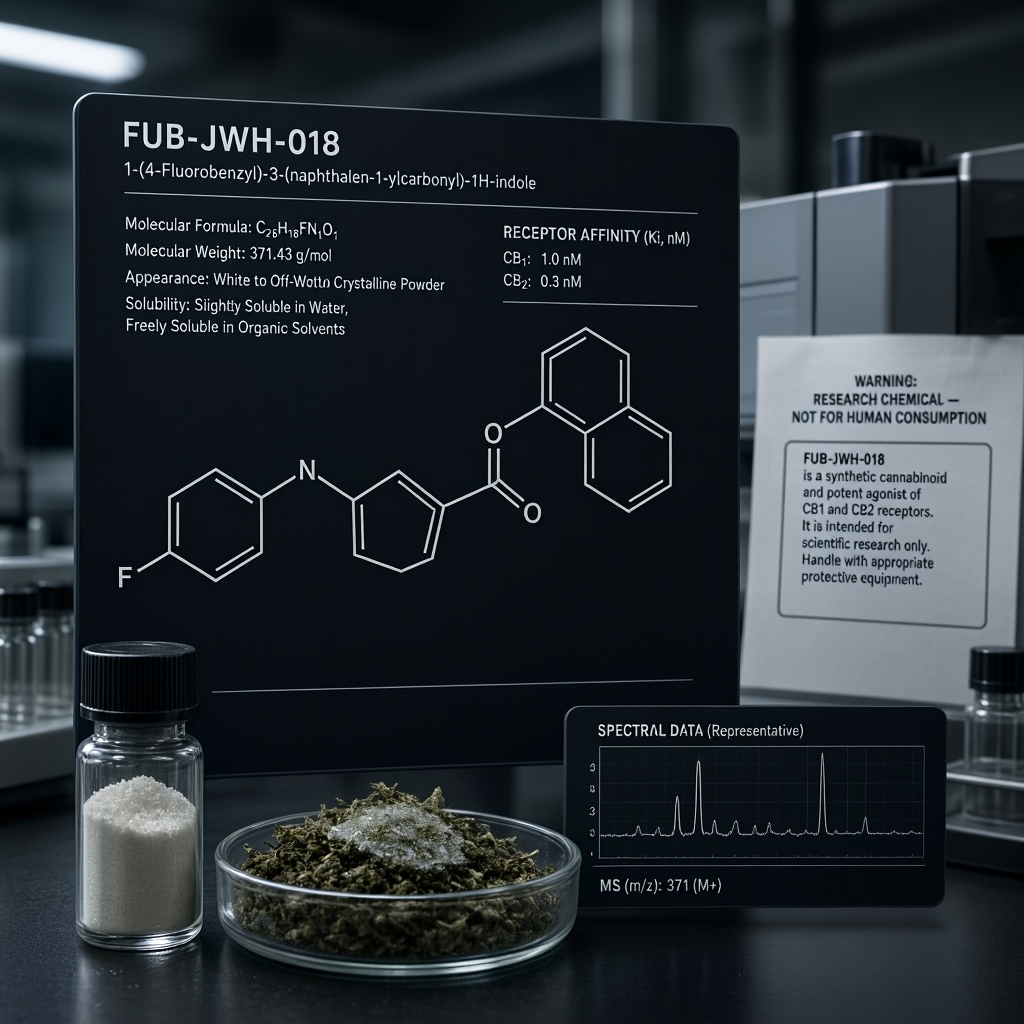
FUB-JWH-018 is a synthetic cannabinoid with a fluorobenzyl group. Used in analytical research. Purity ≥98% (HPLC). For research purposes only.
Product Name: FUB-JWH-018 Synonyms: JWH-018 N-(4-fluorobenzyl) analog; (1-(4-fluorobenzyl)-1H-indol-3-yl)(naphthalen-1-yl)methanone
General Description: FUB-JWH-018 is formally described as (1-(4-fluorobenzyl)-1H-indol-3-yl)(naphthalen-1-yl)methanone. It is a synthetic, highly psychoactive molecule belonging to the aminoalkylindole class of synthetic cannabinoids (SCs). Structurally, it is a targeted designer derivative of the first-generation synthetic cannabinoid JWH-018. It differs from its parent compound via the replacement of the N-pentyl chain with an N-(4-fluorobenzyl) group—a structural modification (the “FUB” moiety) that became highly prevalent in designer cannabinoids (such as AB-FUBINACA and FUB-PB-22) to circumvent early legislation specifically targeting alkyl chain lengths.
In analytical, clinical, and forensic toxicology, FUB-JWH-018 is utilized as a fundamental reference standard. It is essential for the calibration of analytical instrumentation (such as LC-MS/MS and GC-MS) and the development of screening methodologies to identify and quantify the substance in seized “herbal incense” blends (colloquially known as “Spice” or “K2”), adulterated materials, or biological matrices (e.g., whole blood, plasma, urine).
Technical Information:
- CAS Number: N/A (As a highly specific designer analogue, a definitive CAS registry number may not be universally established or utilized across all commercial chemical databases)
- Molecular Formula: C<sub>26</sub>H<sub>18</sub>FNO
- Formula Weight: 379.4 g/mol
- SMILES: O=C(C1=C2C=CC=CC2=CC=C1)C3=CN(CC4=CC=C(F)C=C4)C5=CC=CC=C53
- Formulation: Typically supplied as a neat white-to-off-white crystalline solid or as a certified reference material solution (e.g., 1 mg/mL or 100 µg/mL in methanol or acetonitrile).
Biological Action: Like its parent compound JWH-018, FUB-JWH-018 acts as a highly potent, non-selective full agonist at the central cannabinoid type 1 (CB<sub>1</sub>) and peripheral cannabinoid type 2 (CB<sub>2</sub>) receptors. While it binds to the same primary receptors as Δ<sup>9</sup>-THC (the primary psychoactive component of natural cannabis), its nature as a full agonist (rather than a partial agonist) strips away the natural ceiling effect of THC. This profound hyperactivation of the endocannabinoid system mediates intense and highly unpredictable psychoactive effects. Acute intoxication is notoriously associated with severe toxidromes, including profound tachycardia, hypertension, intense paranoia, severe synthetic cannabinoid-induced psychosis, seizures, and potentially fatal cardiovascular or renal emergencies.
| Weight | 0.01 kg |
|---|
Be the first to review “FUB-JWH-018”
Related products

Cannabinoids

Cannabinoids

Cannabinoids

Cannabinoids
Cannabinoids
Cannabinoids
Cannabinoids
Cannabinoids
Reviews
There are no reviews yet.