

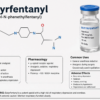
**Product Name:** Tianeptine Sulfate
**Synonyms:** Tianeptine hemisulfate monohydrate; THM; 7-[(3-chloro-6-methyl-5,5-dioxo-11H-benzo[c][2,1]benzothiazepin-11-yl)amino]heptanoic acid hemisulfate monohydrate
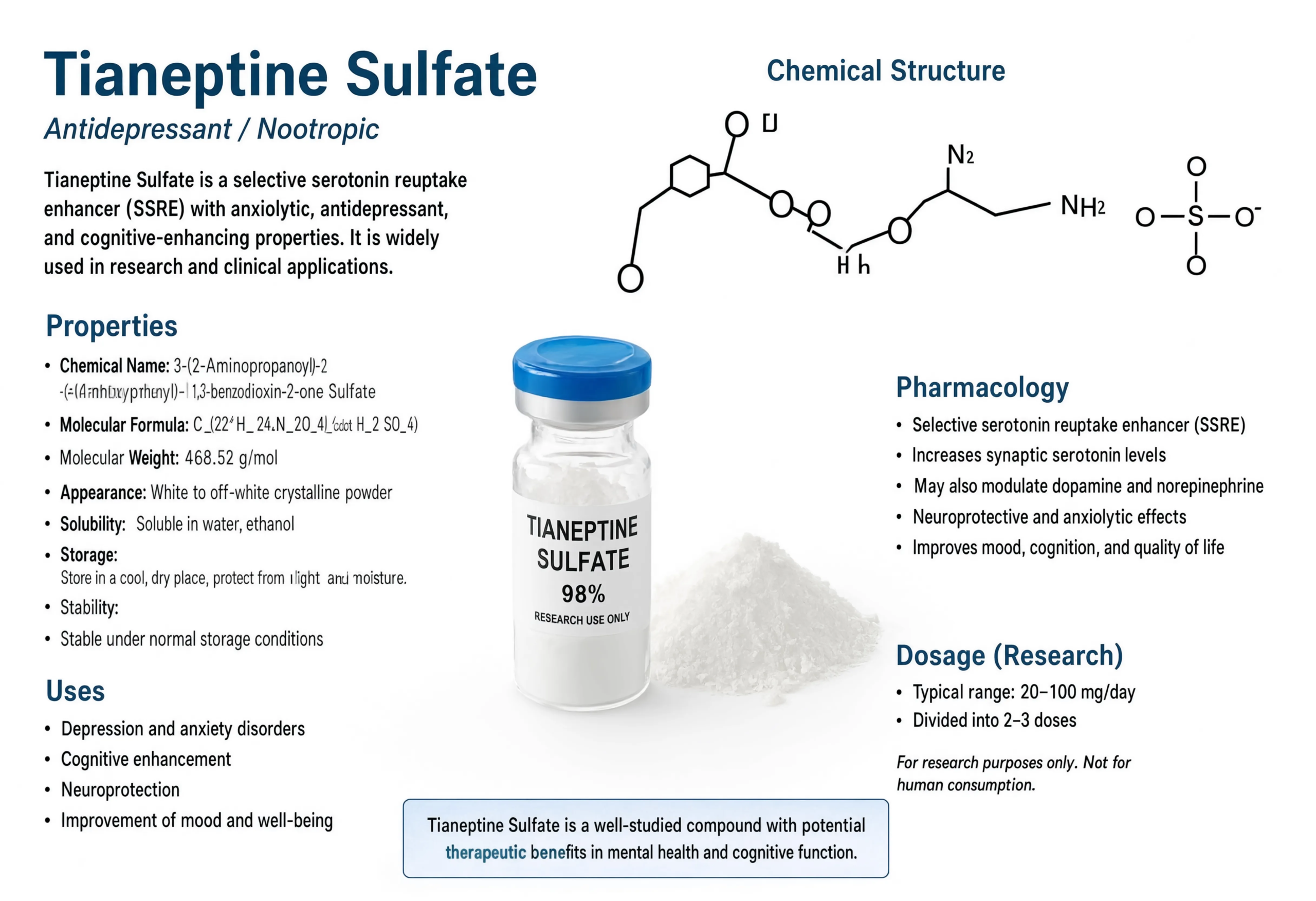
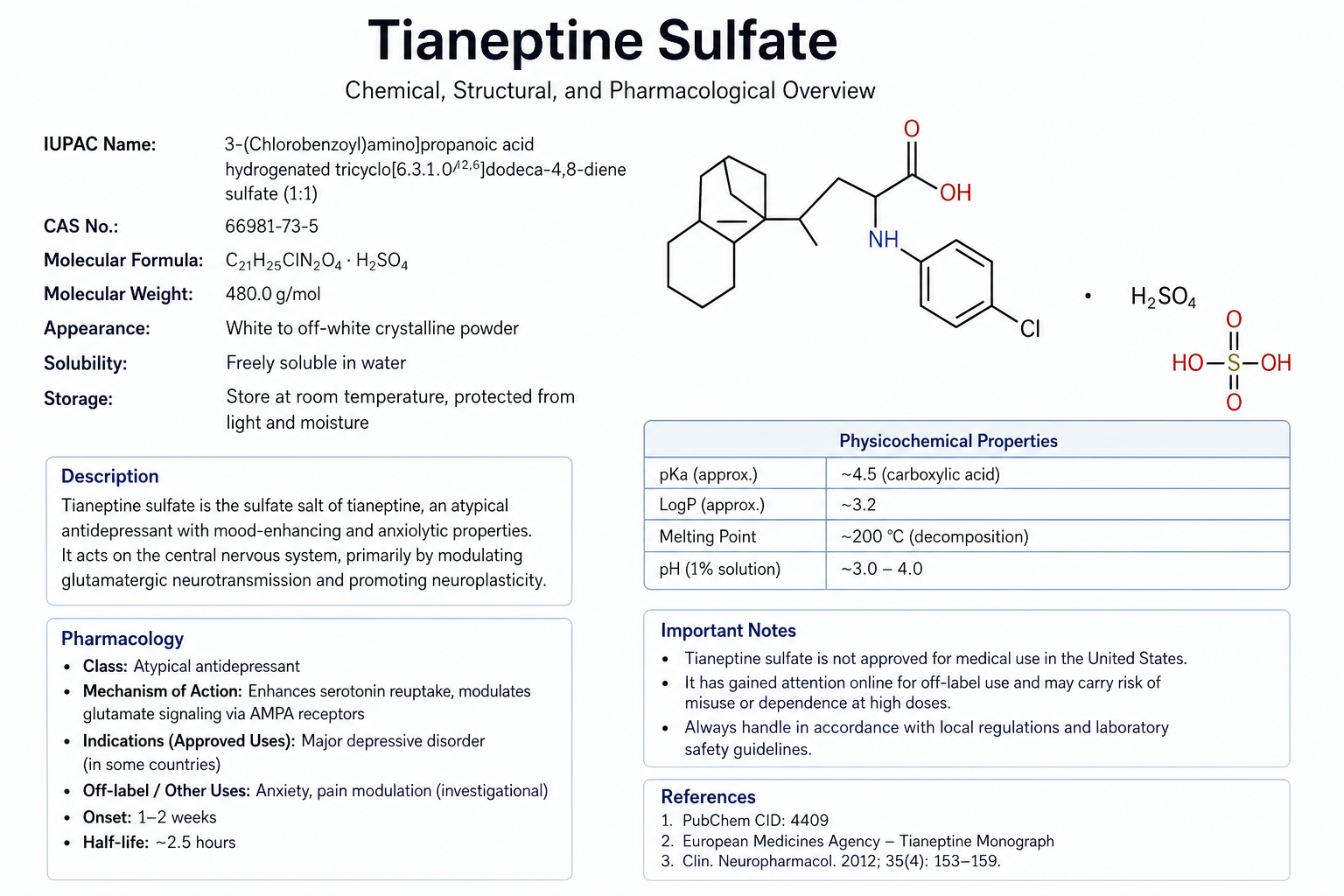
**General Description:** Tianeptine sulfate is formally described as 7-[(3-chloro-6-methyl-5,5-dioxo-11H-benzo[c][2,1]benzothiazepin-11-yl)amino]heptanoic acid (sulfate salt). It is an atypical tricyclic compound. While tianeptine is utilized clinically in several European, Latin American, and Asian countries as an antidepressant and anxiolytic (typically administered as the highly hygroscopic sodium salt under the trade names Stablon or Coaxil), the sulfate salt formulation is notable for its improved chemical stability and a prolonged pharmacokinetic half-life. In analytical, clinical, and forensic toxicology, tianeptine sulfate is utilized as a reference standard for the calibration of analytical instrumentation (such as LC-MS/MS and GC-MS) and the development of screening methodologies to identify and quantify the substance in seized materials, illicit dietary supplements, or biological matrices.
**Technical Information (Hemisulfate Monohydrate):** *
**CAS Number:** 1224690-84-9 (Hemisulfate monohydrate) / 66981-73-5 (Free acid) * **Molecular Formula:** C<sub>42</sub>H<sub>56</sub>Cl<sub>2</sub>N<sub>4</sub>O<sub>14</sub>S<sub>3</sub> *[2(C<sub>21</sub>H<sub>25</sub>ClN<sub>2</sub>O<sub>4</sub>S) • H<sub>2</sub>SO<sub>4</sub> • 2(H<sub>2</sub>O)]* *
**Formula Weight:** 1008.0 g/mol * **SMILES:** CN1C2=CC=CC=C2C(C3=C(S1(=O)=O)C=C(C=C3)Cl)NCCCCCCC(=O)O (Free acid) * **InChI Key:** KVVMXNNJBVTOSX-UHFFFAOYSA-N *
**Formulation:** Typically supplied as a neat white crystalline solid or as a certified reference material solution (e.g., 1 mg/mL in methanol). **Biological Action:*
* Historically mischaracterized as a selective serotonin reuptake enhancer (SSRE), more recent pharmacological profiling has revealed that tianeptine is an atypical, full agonist at the μ-opioid receptor (MOR), with weaker activity at the δ-opioid receptor (DOR). It also modulates the glutamatergic system, affecting AMPA and NMDA receptor transmission, which is believed to mediate its neuroplastic and antidepressant effects at therapeutic doses. At supratherapeutic doses, its opioid receptor agonism drives significant abuse potential, yielding euphoria, respiratory depression, and classic opioid-like withdrawal syndromes.
**Regulatory and Safety Information:** *
**Intended Use:** This product is intended strictly for use as an analytical reference standard for forensic, toxicological, and academic research purposes.
* **Warning:** **This product is not for human or veterinary use.** *
**Legal Status:** The regulatory status of tianeptine varies widely. In the United States, tianeptine is not approved by the Food and Drug Administration (FDA) for any medical use. Due to severe cases of toxicity, withdrawal, and a surge in illicit use (where it is often colloquially marketed in gas stations and online as a “legal high” or “gas station heroin”), tianeptine and its salts have been placed under strict control as Schedule I or Schedule II substances in numerous U.S. states (including Alabama, Florida, Michigan, Tennessee, and others). It is also heavily regulated or banned in various European countries. Procurement may require relevant local licenses. Handling should only occur within professional laboratory environments using appropriate Personal Protective Equipment (PPE) such as safety glasses, chemical-resistant gloves, and a laboratory coat.
| Weight | 0.01 kg |
|---|
Be the first to review “Tianeptine Sulfate”
Related products
Opioids

Opioids

Opioids
![Product Name: O-DSMT (O-Desmethyltramadol) Synonyms: Desmetramadol; 3-(2-((dimethylamino)methyl)-1-hydroxycyclohexyl)phenol; O-Desmethyl tramadol General Description: O-DSMT is formally described as 3-[2-[(dimethylamino)methyl]-1-hydroxycyclohexyl]phenol. It is a synthetic, psychoactive molecule belonging to the cyclohexanol class. O-DSMT is the primary biologically active metabolite of the widely prescribed atypical opioid analgesic tramadol. In the body, tramadol is metabolized into O-DSMT by the hepatic enzyme CYP2D6. In recent years, O-DSMT has also emerged independently on the illicit designer drug market as a novel psychoactive substance (NPS). In analytical, clinical, and forensic toxicology, O-DSMT is utilized as a fundamental reference standard. It is essential for the calibration of analytical instrumentation (such as LC-MS/MS, GC-MS, and HPLC) and the development of screening methodologies to identify and quantify the substance in seized materials, adulterated illicit street drugs, or biological matrices (e.g., whole blood, plasma, urine), both to detect illicit use and to monitor tramadol metabolism. Technical Information (Hydrochloride Salt): CAS Number: 144514-41-4 (Hydrochloride) / 73986-53-5 (Freebase) Molecular Formula: C15H23NO2 • HCl Formula Weight: 285.8 g/mol (Hydrochloride) / 249.35 g/mol (Freebase) SMILES: CN(C)CC1(CCCCC1O)C2=CC(=CC=C2)O.Cl InChI Key: HKSZLNNCZMWEAE-UHFFFAOYSA-N (Freebase) Formulation: Typically supplied as a neat white crystalline solid or as a certified reference material solution (e.g., 1 mg/mL or 100 µg/mL in methanol). Biological Action: O-DSMT acts as a high-affinity agonist at the μ-opioid receptor (MOR). Notably, its affinity and efficacy at the MOR are significantly higher than those of its parent compound, tramadol. Consequently, O-DSMT is responsible for the vast majority of the classical opioid analgesic effects observed following tramadol administration. Unlike tramadol, which acts as a prominent serotonin-norepinephrine reuptake inhibitor (SNRI), O-DSMT retains primarily norepinephrine reuptake inhibition (NRI) properties and has negligible affinity for the serotonin transporter. At supratherapeutic doses, O-DSMT carries a significant risk of classical opioid toxidromes, including profound respiratory depression, sedation, miosis, and euphoria. Regulatory and Safety Information: Intended Use: This product is intended strictly for use as an analytical reference standard for forensic, toxicological, and academic research purposes. Warning: This product is a potent opioid and carries a severe risk of physiological dependence and fatal overdose. It is not for human or veterinary use outside of strictly approved clinical or laboratory environments. Legal Status: The regulatory status of O-DSMT varies globally and is subject to change as its prevalence as an NPS increases. In the United States, tramadol is a Schedule IV Controlled Substance, and while O-DSMT has historically occupied a grey area, it is increasingly being placed under independent scheduling by various state legislatures and international regulatory bodies. Procurement may require relevant local or institutional licenses. Handling should only occur within professional laboratory environments using appropriate Personal Protective Equipment (PPE) such as safety glasses, chemical-resistant gloves, and a laboratory coat to prevent accidental exposure.](https://k2researchchemicals.com/wp-content/uploads/2026/06/1783376742245-019f3988-d914-7317-b13b-e9ac3ef53f74-300x300.png)
Opioids
Opioids
Opioids
Opioids
Reviews
There are no reviews yet.