

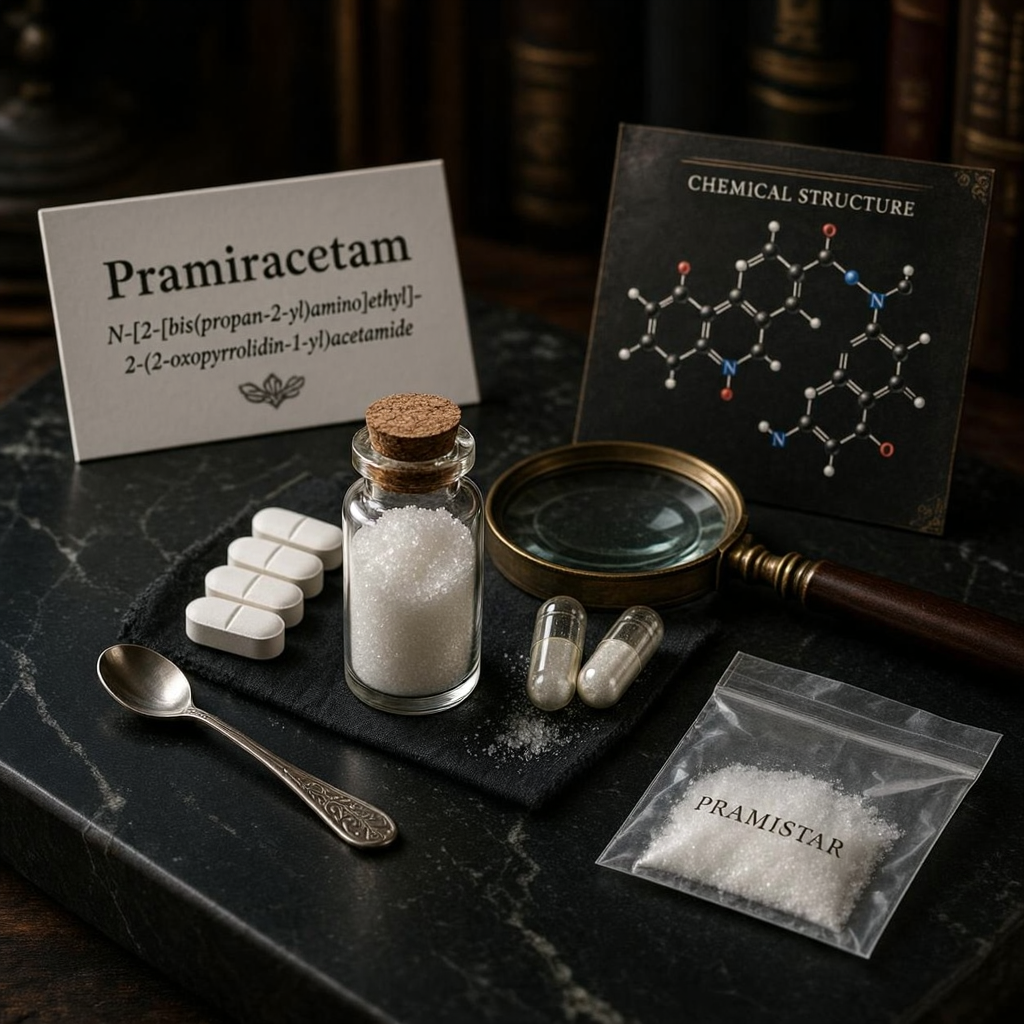


Product Name: Pramiracetam Synonyms: CI-879; Pramistar; Neupramir; Remen; N-[2-(diisopropylamino)ethyl]-2-(2-oxopyrrolidin-1-yl)acetamide
General Description: Pramiracetam is formally described as N-[2-[bis(propan-2-yl)amino]ethyl]-2-(2-oxopyrrolidin-1-yl)acetamide. It is a synthetic, centrally acting small molecule belonging to the racetam family of nootropic (cognitive-enhancing) compounds. Originally synthesized by researchers at Parke-Davis in the late 1970s, it is a structural derivative of piracetam, modified by substituting the amide group with a diisopropylaminoethyl chain. This substitution renders pramiracetam significantly more lipophilic (fat-soluble) and substantially more potent by weight than its parent compound.
In analytical, clinical, and academic toxicology, pramiracetam is utilized as a fundamental reference standard. It is essential for the calibration of analytical instrumentation (such as LC-MS/MS, GC-MS, and HPLC) and the development of screening methodologies to identify and quantify the substance in grey-market dietary supplements, experimental nootropic blends, or biological matrices.
Technical Information (Freebase):
- CAS Number: 68497-62-1 (Freebase) / 72869-16-0 (Sulfate salt)
- Molecular Formula: C<sub>14</sub>H<sub>27</sub>N<sub>3</sub>O<sub>2</sub>
- Formula Weight: 269.39 g/mol (Freebase)
- SMILES: CC(C)N(C(C)C)CCNC(=O)CN1CCCC1=O
- InChI Key: NCSHCALIXZMFNJ-UHFFFAOYSA-N
- Formulation: Typically supplied as a neat white-to-off-white crystalline solid (can be formulated as a sulfate salt to improve aqueous solubility) or as a certified reference material solution (e.g., 1 mg/mL in methanol).
Biological Action: The precise mechanism of action for pramiracetam is not completely elucidated, but its primary pharmacological target is the cholinergic system. Experimental studies indicate that it significantly increases high-affinity choline uptake (HACU) in the hippocampus, which is the rate-limiting step in the synthesis of the neurotransmitter acetylcholine. This upregulation heavily mediates its memory-enhancing and learning properties. Notably, unlike classical psychostimulants or even some other racetams, pramiracetam does not appear to exhibit meaningful direct binding affinity for central dopamine, serotonin, norepinephrine, or GABA receptors, nor does it strongly modulate AMPA receptors. Further preclinical research suggests it may also influence cerebral nitric oxide (NO) synthesis pathways.
Regulatory and Safety Information:
- Intended Use: This product is intended strictly for use as an analytical reference standard for forensic, toxicological, and academic research purposes.
- Warning: This product is an unapproved investigational compound in many jurisdictions. It is not for human or veterinary use outside of approved clinical applications.
| Weight | 0.01 kg |
|---|
Be the first to review “Pramiracetam 1o grams”
Related products

Nootropics


Nootropics
Nootropics

Nootropics

Nootropics

Nootropics


Nootropics
Nootropics
Reviews
There are no reviews yet.