

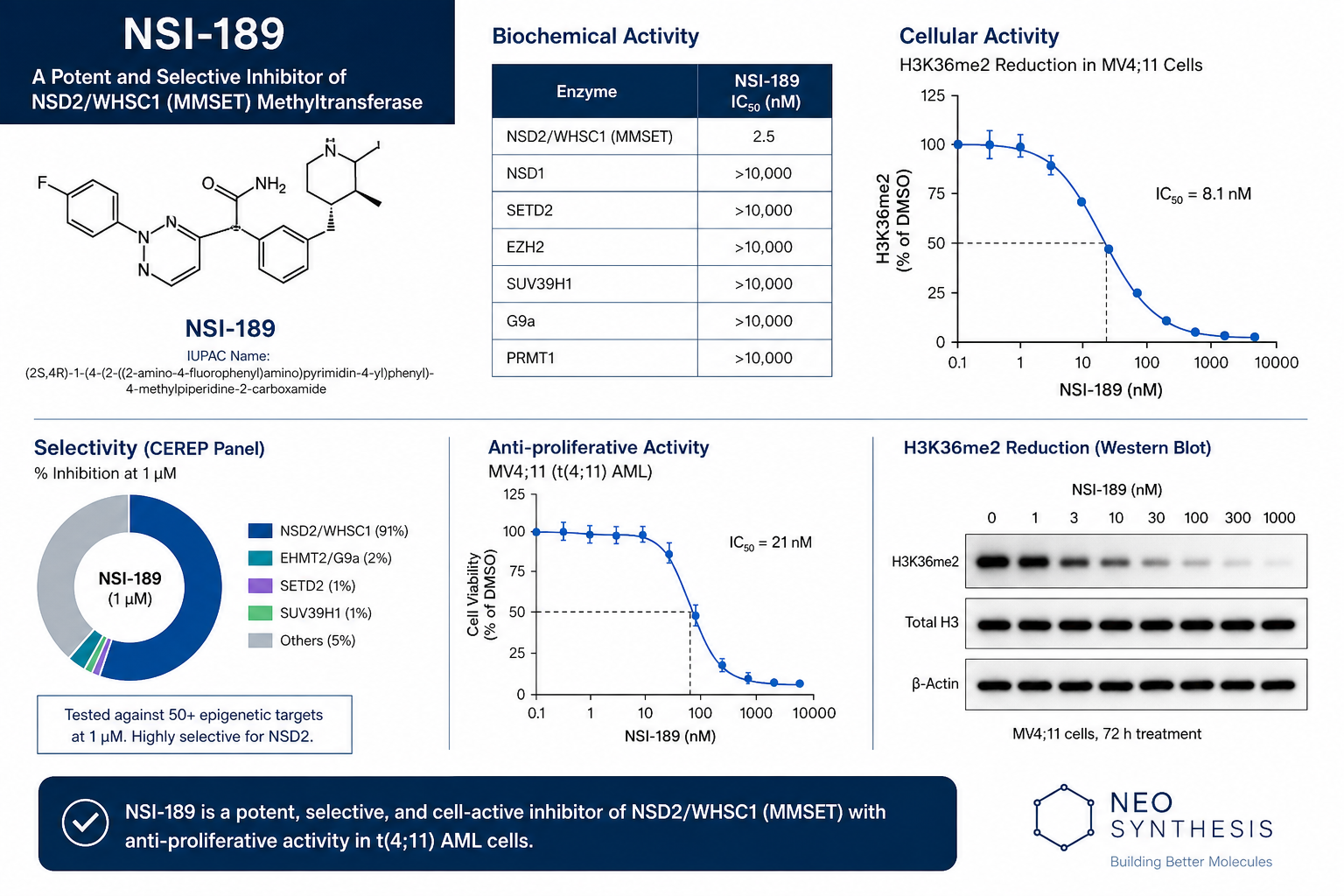

Product Name: NSI-189 Synonyms: Amdiglurax; ALTO-100; (4-Benzylpiperazin-1-yl)-[2-(3-methylbutylamino)pyridin-3-yl]methanone; NSI-189 Phosphate12
General Description: NSI-189 is formally described as (4-benzylpiperazin-1-yl)-[2-(3-methylbutylamino)pyridin-3-yl]methanone.123 It is an experimental, highly novel synthetic small molecule characterized primarily as a hippocampal neurogenesis stimulant.34 Originally discovered and developed by Neuralstem, Inc. (and recently investigated clinically under the generic name amdiglurax or developmental code ALTO-100), NSI-189 has been extensively researched as a potential therapeutic for major depressive disorder (MDD), traumatic brain injury (TBI), cognitive impairment, and neurodegeneration.13 Outside of clinical trials, it has also garnered significant interest within the experimental nootropic and research chemical communities.34
In analytical and academic settings, NSI-189 is utilized as a reference standard for the calibration of analytical instrumentation (such as LC-MS/MS, GC-MS, and HPLC), the identification of the substance in grey-market products, and for in vitro and in vivo neuropharmacological research into neuroplasticity.34
Technical Information (Phosphate Salt):
- CAS Number: 1270138-41-4 (Phosphate) / 1270138-40-3 (Freebase)123
- Molecular Formula: C<sub>22</sub>H<sub>30</sub>N<sub>4</sub>O12 • H<sub>3</sub>PO<sub>4</sub>
- Formula Weight: 464.5 g/mol (Phosphate salt) / 366.5 g/mol (Freebase)23
- SMILES: CC(C)CCNC1=C(C=CC=N1)C(=O)N2CCN(CC2)CC3=CC=CC=C3.OP(=O)(O)O
- InChI Key: LWHMGALTTIYPJU-UHFFFAOYSA-N (Phosphate) / DYTOQURYRYYNOR-UHFFFAOYSA-N (Freebase)123
- Formulation: Typically supplied as a neat off-white to white crystalline solid (frequently formulated as a phosphate salt to ensure optimal chemical stability and aqueous solubility) or as a certified reference material solution (e.g., 1 mg/mL in methanol or DMSO).123
Biological Action: Unlike classical antidepressants such as selective serotonin reuptake inhibitors (SSRIs) or monoamine oxidase inhibitors (MAOIs), NSI-189 does not directly modulate monoamine reuptake or transmission.123 Instead, its primary observed mechanism involves the profound stimulation of neurogenesis in the subventricular zone and the dentate gyrus of the hippocampus.34 Experimental models indicate that it acts to indirectly enhance Brain-Derived Neurotrophic Factor (BDNF) signaling, leading to measurable increases in hippocampal volume, dendritic spine density, and enhanced synaptic plasticity.34 The precise primary molecular target (receptor binding site) remains undisclosed or unidentified.23
Regulatory and Safety Information:
- Intended Use: This product is intended strictly for use as an analytical reference standard for forensic, toxicological, and academic research purposes.34
- Warning: This product is an experimental investigational compound. It is not for human or veterinary use.34
- Legal Status: NSI-189 is currently an unscheduled substance in the United States at the federal level and is not controlled under international UN drug conventions.34 However, it remains an unapproved Investigational New Drug (IND) and is not cleared by the Food and Drug Administration (FDA) or the European Medicines Agency (EMA) for human consumption, medical use, or inclusion in dietary supplements.34 While procurement of the bulk active pharmaceutical ingredient (API) for analytical research requires no special DEA licenses, handling must occur strictly within professional laboratory environments using appropriate Personal Protective Equipment (PPE) such as safety glasses, chemical-resistant gloves, and a laboratory coat.34
| Weight | 0.01 kg |
|---|
Be the first to review “NSI-189”
Related products

Nootropics

Nootropics

Nootropics
Nootropics

Nootropics

Nootropics

Nootropics


Nootropics
Reviews
There are no reviews yet.