


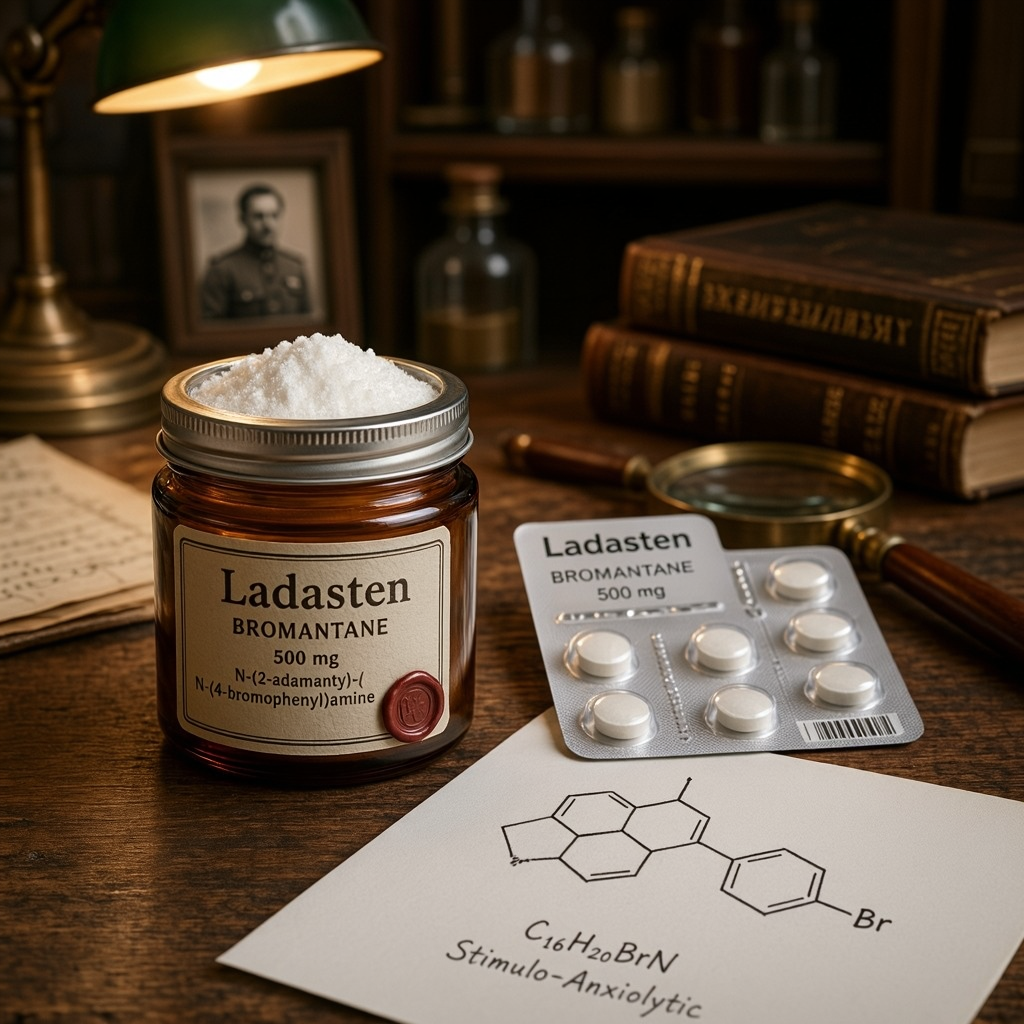


Product Name: Bromantane Synonyms: Ladasten; Bromantan; N-(4-bromophenyl)adamantan-2-amine; N-(2-adamantyl)-N-(4-bromophenyl)amine; ADK-709
General Description: Bromantane is formally described as N-(4-bromophenyl)adamantan-2-amine. It is a synthetic, centrally acting small molecule belonging to the adamantane derivative class (sharing structural similarities with antiviral and antiparkinsonian agents like amantadine and memantine). Originally developed in the Soviet Union in the 1980s, bromantane is uniquely classified as an “actoprotector”—a pharmacological agent that enhances physical and mental work capacity under extreme environmental conditions (e.g., hypoxia, high temperatures) without significantly increasing oxygen consumption or causing subsequent physiological exhaustion.
In analytical, clinical, sports, and forensic toxicology, bromantane is utilized as a fundamental reference standard. It is essential for the calibration of analytical instrumentation (such as LC-MS/MS and GC-MS) and the development of screening methodologies to identify the substance in grey-market dietary supplements, experimental nootropic blends, or biological matrices (particularly in anti-doping contexts).
Technical Information:
- CAS Number: 87913-26-6
- Molecular Formula: C<sub>16</sub>H<sub>20</sub>BrN
- Formula Weight: 306.24 g/mol
- SMILES: BrC1=CC=C(NC2C3CC4CC(C3)CC2C4)C=C1
- InChI Key: UVSZNWXNKXNPEV-UHFFFAOYSA-N
- Formulation: Typically supplied as a neat white-to-off-white crystalline solid or as a certified reference material solution (e.g., 1 mg/mL in methanol or acetonitrile).
Biological Action: Bromantane possesses a highly atypical pharmacological profile that distinguishes it from classical psychomotor stimulants (such as amphetamines or methylphenidate). Instead of directly binding to monoamine transporters to block reuptake or induce the release of stored neurotransmitters, bromantane acts primarily via epigenetic mechanisms to upregulate the expression of two key rate-limiting enzymes: Tyrosine Hydroxylase (TH) and Aromatic L-amino acid decarboxylase (AAAD). This leads to an increase in the endogenous synthesis of dopamine in the brain.
Because it enhances the natural synthesis of dopamine rather than forcing its release, bromantane produces mild stimulatory and ergogenic (performance-enhancing) effects that are notably devoid of a hyperactive “rush” or the classical stimulant “crash” and withdrawal. Furthermore, it simultaneously exhibits notable anxiolytic (anti-anxiety) properties, a rare combination for a central stimulant, likely mediated through secondary interactions with the serotonergic and GABAergic systems.
Regulatory and Safety Information:
- Intended Use: This product is intended strictly for use as an analytical reference standard for forensic, toxicological, and academic research purposes.
- Warning: This product is an unapproved investigational compound. It is not for human or veterinary use outside of strictly approved clinical applications.
- Legal Status: The regulatory status of bromantane varies globally. While it was approved as a pharmaceutical in Russia (under the trade name Ladasten), it was officially banned by the World Anti-Doping Agency (WADA) in 1996 following its widespread use as a performance-enhancing drug during the Atlanta Olympic Games. In the United States, bromantane is an unscheduled substance and is not controlled under the Controlled Substances Act (CSA). However, the Food and Drug Administration (FDA) does not recognize bromantane as a legitimate dietary ingredient and classifies it as an unapproved new drug. Procurement of the bulk material for analytical research requires no special DEA licenses, but handling must occur strictly within professional laboratory environments using appropriate Personal Protective Equipment (PPE) such as safety glasses, chemical-resistant gloves, and a laboratory coat.
| Weight | 0.01 kg |
|---|
Be the first to review “Bromantane”
Related products
Nootropics
Nootropics

Nootropics

Nootropics
Nootropics

Nootropics
Nootropics

Nootropics
Reviews
There are no reviews yet.