


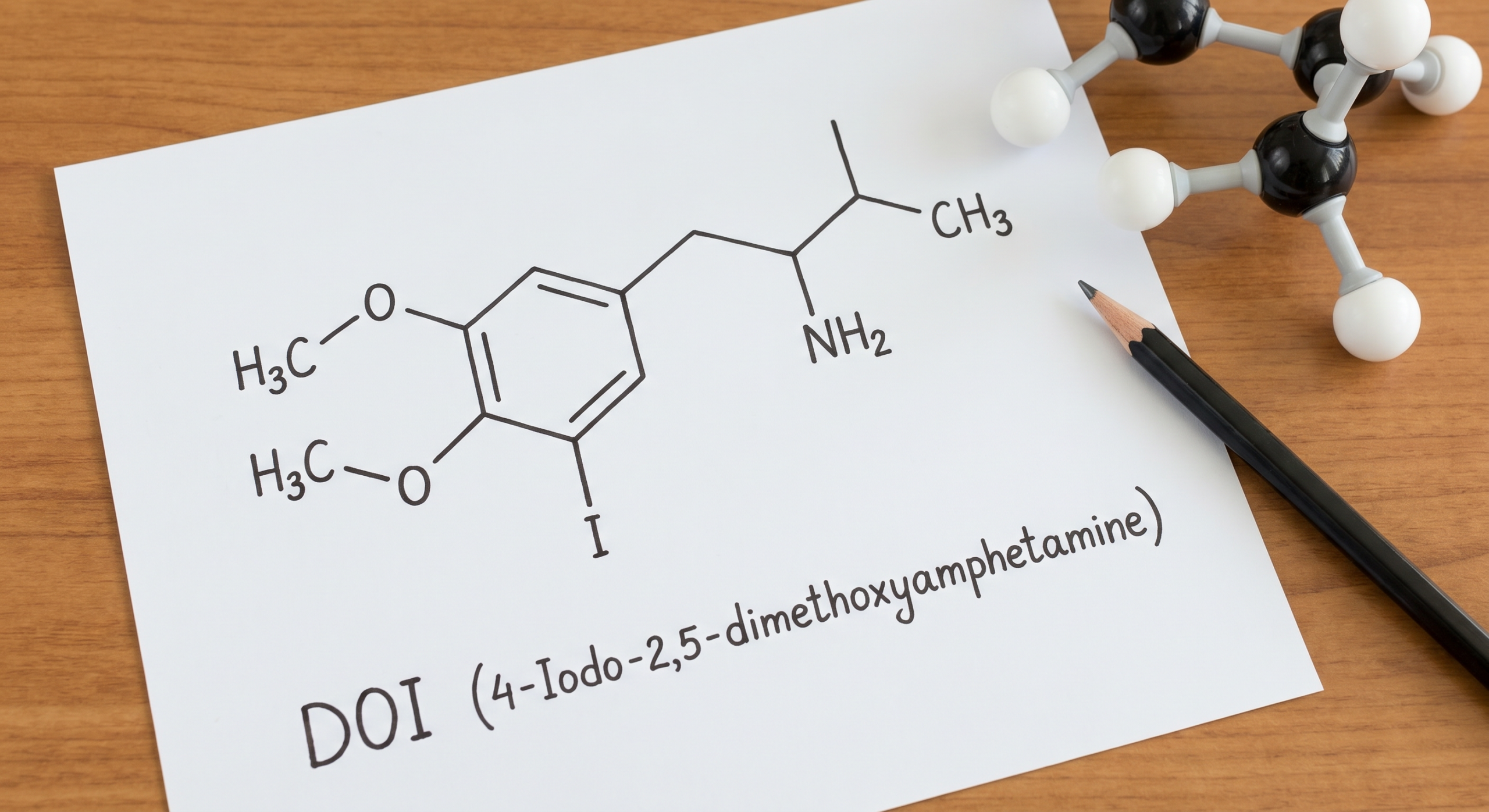

DOI (4-Iodo-2,5-dimethoxyamphetamine)
Overview
DOI is a synthetic psychedelic and substituted amphetamine in the phenethylamine family. It is the 4-iodo analogue of DOM and is structurally closely related to the broader 2,5-dimethoxy series described by Alexander Shulgin. DOI is particularly notable as one of the most widely used research ligands for studying serotonin 5-HT₂A and 5-HT₂C receptors in laboratory settings.
- IUPAC name: 1-(4-iodo-2,5-dimethoxyphenyl)propan-2-amine
- Molecular formula: C₁₁H₁₆INO₂
- Molecular weight: ~321.16 g/mol
- CAS Number: 42200-33-9 (hydrochloride: 42200-42-0)
- Class: Psychedelic phenethylamine; selective 5-HT₂A/2C agonist
History & Origin
DOI was first synthesized in the 1970s as part of systematic investigations into the structure–activity relationships of 2,5-dimethoxy phenethylamines. It was documented in Shulgin’s PiHKAL (entry #67) and became a standard pharmacological tool compound due to its high selectivity and potency at serotonin receptors.
Pharmacology
DOI is considered one of the most selective and potent 5-HT₂A/2C agonists available. Because of this, it is widely cited in neuroscience and receptor-binding research rather than used as a recreational substance.
- Receptor binding: Potent full agonist at 5-HT₂A and 5-HT₂C; partial agonist at 5-HT₂B
- Onset: 30–90 minutes (oral)
- Duration: 8–16 hours
- Active oral dose range: ~1.5–3 mg
Research uses include:
- Mapping 5-HT₂A receptor distribution in the brain
- Studying signal transduction pathways of serotonin receptors
- Modeling hallucinogenic activity in animal models (head-twitch response)
Documented Effects (Shulgin, PiHKAL)
At common doses, effects are similar in character to other 2,5-dimethoxy phenethylamines:
- Visual distortions and pattern enhancement
- Time dilation
- Emotional lability, ranging from euphoria to anxiety
- Introspective, “analytical” quality to the experience
- Body load, mild nausea, and stimulation
At higher doses, intensity increases substantially, with potential for confusion, anxiety, and prolonged insomnia.
Safety & Harm Considerations
- Strong 5-HT₂B agonism raises theoretical concerns for cardiac valvulopathy with chronic or repeated use.
- Long duration and steep dose–response curve increase risk of overwhelming experiences.
- Dangerous interactions possible with MAOIs, SSRIs, SNRIs, tramadol, and other serotonergic substances (serotonin syndrome risk).
- Tolerance develops quickly (cross-tolerance with other 5-HT₂A agonists) and resets within ~3–5 days.
- Iodine content is not a clinical concern at typical doses but reflects its structural origin as a substituted analogue.
| Weight | 0.01 kg |
|---|---|
| Quantity | 10 grams, 25 grams, 35 grams, 55 grams |
Be the first to review “DOI (4-Iodo-2,5-dimethoxyamphetamine)”
Related products
Phenethylamines
Phenethylamines
Phenethylamines

Phenethylamines
Phenethylamines

Phenethylamines

Phenethylamines

Phenethylamines
Reviews
There are no reviews yet.